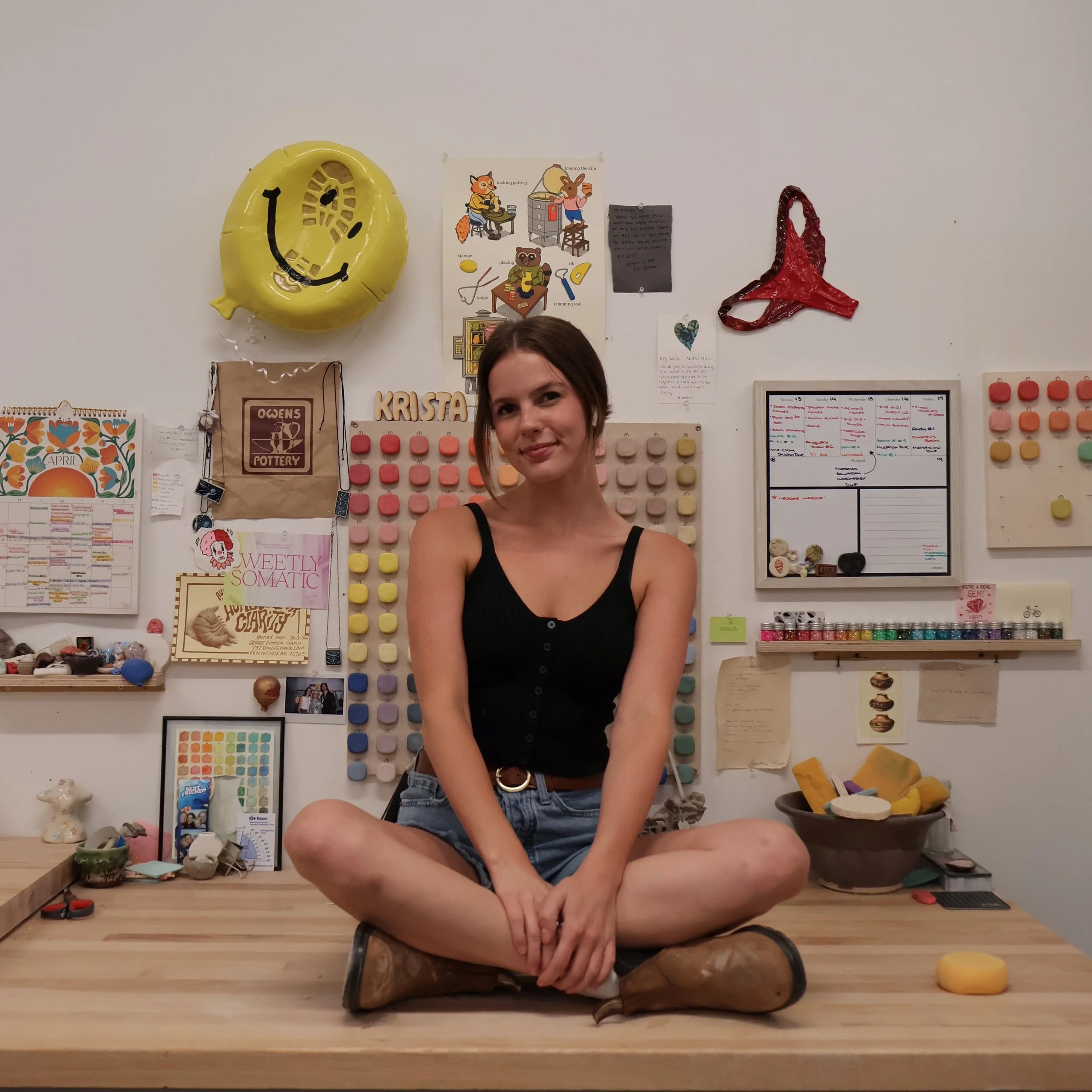
Krista Willey is a ceramic artist who enjoys pushing the boundaries of what clay is traditionally thought to be able to withstand and uses a variety of innovative techniques to highlight and bring awareness to women's reproductive health and political history. Most recently, she was a ceramic artist in residence at Tainan National University of the Arts in the countryside of Taiwan and also spent time at Chin Chin Gallery and Studio in Tainan City, Taiwan. Before that, she was a post-baccalaureate student in ceramics at the University of Arkansas for two years exploring new ideas for her activism work including women’s rights, women’s health, and the mix of toxic masculinity and social media’s effect on abuse towards women. She achieved her BFA in Ceramics from the University of North Georgia in May of 2024 where she first started working in clay.
Willey uses hand building techniques with inventive twists in her pieces, rarely sticking to one form of building to allow for a larger range of creative exploration to convey her messages. She grew up in the small town of Covington, Georgia which has influenced her work and activism being inspired by the strong, southern women in her family and recognizing the societal pressures they faced coming from a rural area. Willey is a nationally and internationally exhibited artist, showing her work in shows such as the NCECA Juried Student Exhibition (2026), Pieces of - Solo Exhibition in Tainan, Taiwan (2026) and in the International Ceramic Art Exhibition in Taoxichuan, China (2024). Krista also enjoys creating functional ceramic works on the wheel and has recently been experimenting with incorporating and altering wheel thrown pieces into her advocacy work.
About
Statement
A slip of the hand can lead to the destruction of something so strong that it could have outlasted its maker if only it had been cared for. The nature of “strength” and “fragility” seem so distant from one another, yet there are so many areas in which they find each other and combine into something beyond two simple words.
My work explores the intersection of women’s health and history, with a focus on raising awareness around uterine and ovarian diseases, particularly endometriosis. I have learned to walk hand in hand with pain as it accompanies me in every breath while living with stage four endometriosis. I create work so that other women may have a place in which they are finally listened to, cared for, and can find community. I delve into the silenced experiences of women, bringing attention to the physical and emotional tolls of such conditions. For too long women have had to shout be heard and their pain is still dismissed – I refuse to allow my voice and those of so many others to go unheard.
Strength and fragility intertwine themselves through the materials I work with. Ceramics is considered fragile, yet it is one of few materials that can outlast the memory of its maker and has been reformed through temperatures hotter than fire. The dichotomy of this material that can shatter by the slip of a hand is something I always try to push and examine during my creative process.
Ceramic materials mirror the delicate yet unwavering strength that women have adapted to survive. I aim to break the idea that strong women can’t also be fragile. I draw from the strength and resilience of the southern women in my family who were homemakers, fighters, and survivors of their time. They have passed on the resilience of how to carry strife with grace (bless their hearts). I look back at what they have lived through, fought for, and turned down - the rights that some watched get passed, others were born with, and ones that have been stripped away. My practice is a fusion of my personal narrative and advocacy, using art to amplify voices that have been historically erased. I use a variety of visual techniques from tapecast porcelain as thin as paper to fleshy letters adorned with lace to further push the memory and pain that each piece stems from.
I examine the strength of women, recognizing the truth in what has occurred - the strength that my foremothers had to stand up and fight for what wasn’t ours before. I listen to those around me as doctors dismiss them and I believe the pain they feel, the pain I feel as well. Every march, every bill, and every shout of resilience must be remembered in its entirety so that we may not fall back into what we did not have before. The fragile balance of remembering and repeating history accompany us with every breath simply as we exist as women.